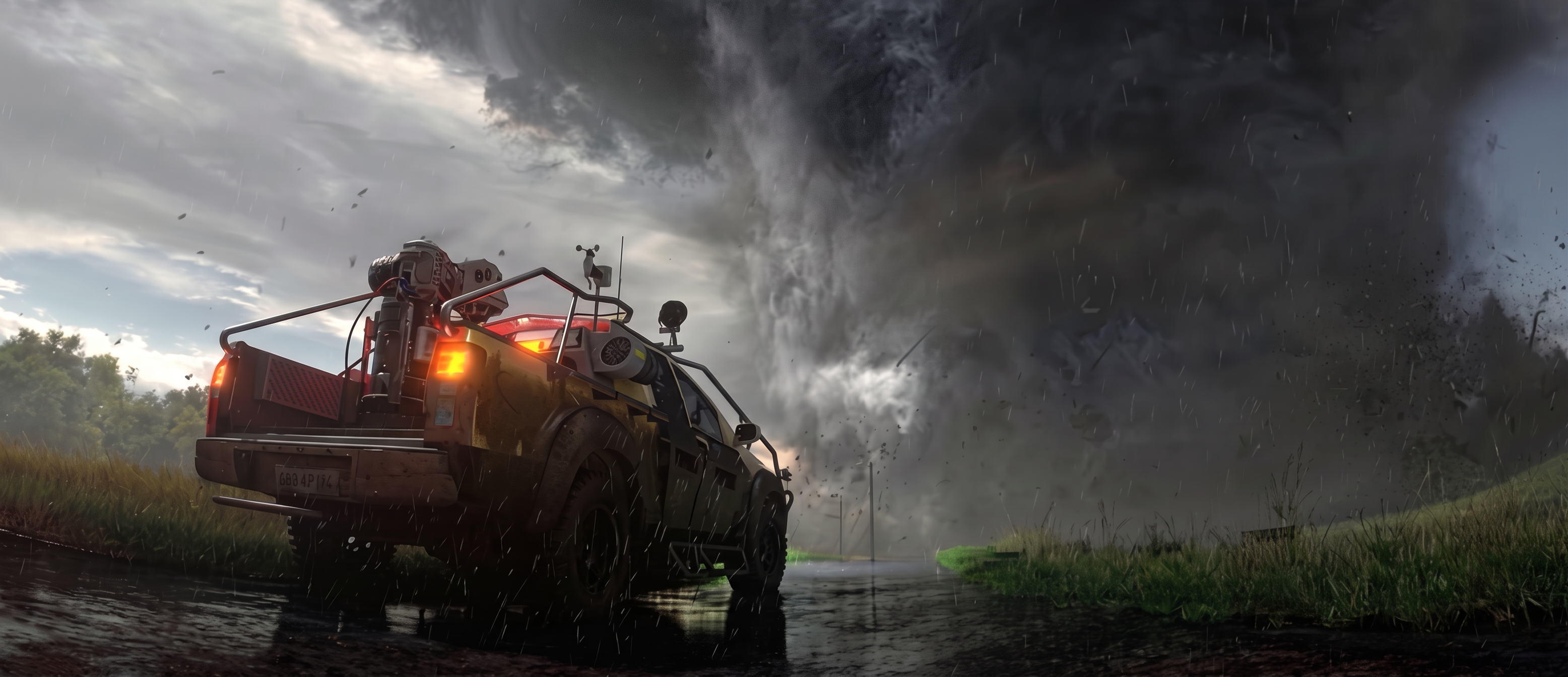
Chasseur de Tornades
Futuroscope • 2022
Project Background
The attraction Chasseurs de Tornades (Tornados Hunters) was my first experience as Lead FX Artist. I worked alongside Loïc Bauer and Anne Bertin on the FX for this project, which was an incredible opportunity for anyone working on FX-heavy films. Tornadoes, storms, destruction, explosions, lightning: it had everything an FX Artist could dream of.
Our passionate work was greatly rewarded, as the production earned the award for Best Attraction in the World at the THEA AWARDS.
The project was highly ambitious: we had to deliver a fully CG short film of nearly five minutes in 10K, with a 240° to 360° cylindrical render. This called for smart decisions and maximum optimization of our scenes and methods to meet the challenge. Rendering was done in Houdini and Redshift. Given the technical nature of the production, my first task, before starting on the FX, was to set up a pipeline and a set of tools for 360° work and cylindrical rendering. I discuss this briefly in my article on Blender to Houdini.
Before going back over my FX work on this project, here is a preview from the attraction.
The Tornadoes
I had the incredible opportunity to be in charge of the project’s hero FX: the tornadoes and the cyclone. Each tornado told a story and served as a narrative element, conveying the storm’s escalating intensity as it builds toward the final cyclone. A small, fast tornado at the start, a large, slow and threatening one, several small, fast and furious ones, a waterspout at one point, and a colossal cyclone at the end: every tornado was carefully choreographed.
The Storm
Tornadoes alone are not enough to create a cataclysmic storm; the audience needs to feel the wind. But wind is invisible and can only be perceived through its interaction with the environment. I therefore developed two main setups to feel the wind:
- The trees: Calm at the beginning and raging wildly by the end, the tree simulations let the audience feel the storm growing increasingly violent as the film progresses. For the calm phase, I created a procedural animation to get a gentle rustling in the branches.
Once the storm is raging, I switch to a wire solver that deforms the trees’ skeletons according to a powerful wind velocity volume, then reapply the skeleton deformation to the geometry. We had nearly 40 different trees across 5 wind intensities. At the time we were working in Houdini 18.5, where Vellum was significantly less efficient than the wire solver for this type of task.
The debris: The second way to feel wind is to see objects flying through the air. The size of the debris also evolves throughout the film. At first, mostly leaves are swept up. As the storm intensifies, branches, roof tiles, stones and more begin to appear. And at the heart of the cyclone, even cars and trucks are carried away!
The Clouds
Then comes the moment when the main character activates an anti-cyclone weapon at the top of the cyclone. It is a magical moment: we emerge from the storm, rise above the clouds, and the sunset comes into view. I was in charge of the entire 3D environment for this sequence. I built a library of clouds and distributed them around the cyclone.