La Cage
Netflix • 2024
I had the opportunity to work on the first two seasons of La Cage as Lead Crowd Artist. As Digital District’s first major crowd project, my primary objective was to build a crowd workflow and toolset in Houdini to match the production’s needs. To that end, we developed DD Crowd.
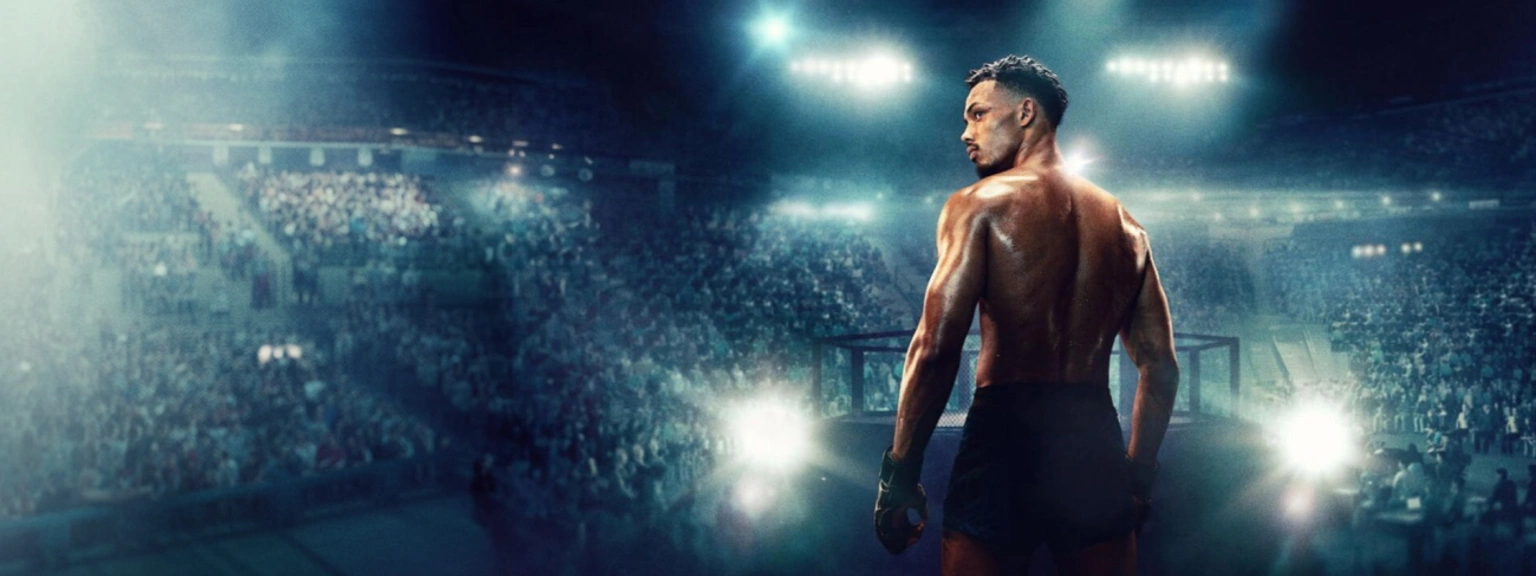
Our role was to deliver over 600 crowd shots across 3 different arenas, ranging from 10,000 to 40,000 people. The crowd had to react convincingly to the action taking place in the octagon as well as to the lighting atmosphere.
Beyond the standard behavior of a seated crowd inside the arenas, it’s worth highlighting some of the specific behaviors developed during production.
One notable example is characters sneaking into rows to reach their seats, or conversely, standing up and making their way out of a row. To achieve this, I randomly selected characters from the crowd, calculated the shortest path for them to enter or exit, and triggered the appropriate animations based on each stage of the agent’s movement.
We also, naturally, had to deal with the classic staircase problem. The series featured two types of staircases: fixed-length and variable-length.
For fixed-length staircases, we were able to use a library of stair-climbing/descending animations, and with a KineFX setup, I adapted procedurally the animation cycle to match the exact length and height of each staircase. However, since Houdini has no KineFX solver, I had to pre-bake the animation clips ahead of the crowd simulation, based on the staircase dimensions in each of our arenas.
For variable-length staircases, adapting the animation cycle on the fly during crowd simulation unfortunately wasn’t an option. To solve this, I used Houdini’s newer Crowd Motion Path tools, projecting a walk cycle onto a slightly smoothed staircase geometry, combined with an Agent Terrain Adaptation node. The result isn’t perfect, some additional pelvis adaptation would have been welcome but our staircases characters were never seen in close-up in the series. The goal was primarily to avoid any jittering visual artifacts rather than spend excessive time perfecting a detail that wouldn’t be noticeable on screen.
Naturally, the characters on the stairs and the walking crowd members also had to avoid idle characters standing in the arena, whether watching the fight or chatting among themselves.
The combination of all these behaviors resulted in a crowd with realistic, believable behavior, which earned us the client’s satisfaction and trust.